
A glass top either protects a surface you already own or becomes the surface itself. Those two jobs call for different glass, and getting the thickness, edge, and safety choices right is most of the work.
Protective covers
A glass cover over a wood dining table, a desk, a dresser, or a nightstand keeps rings, scratches, and everyday wear off the finish. It is not a heat shield: hot cookware still needs a trivet, on glass as on wood. The glass lies flat on the furniture, so it does not need to carry its own weight.
- Thickness. 1/4 inch is the standard. 3/16 inch works on small side tables. Thinner glass tends to show every ripple in the wood underneath.
- Edge. A flat polished edge is clean and safe to the touch. A pencil (rounded) edge softens the look on traditional furniture.
- Corners. Match the furniture: square corners with a light ease, or a radius that follows the top.
- Spacers. Clear rubber bumpers under the glass stop it from sliding and let air circulate so moisture does not get trapped against the finish.
Low-iron glass is worth considering on light-colored wood or painted furniture, where standard clear glass adds a green tint to the surface beneath it.
Freestanding tabletops
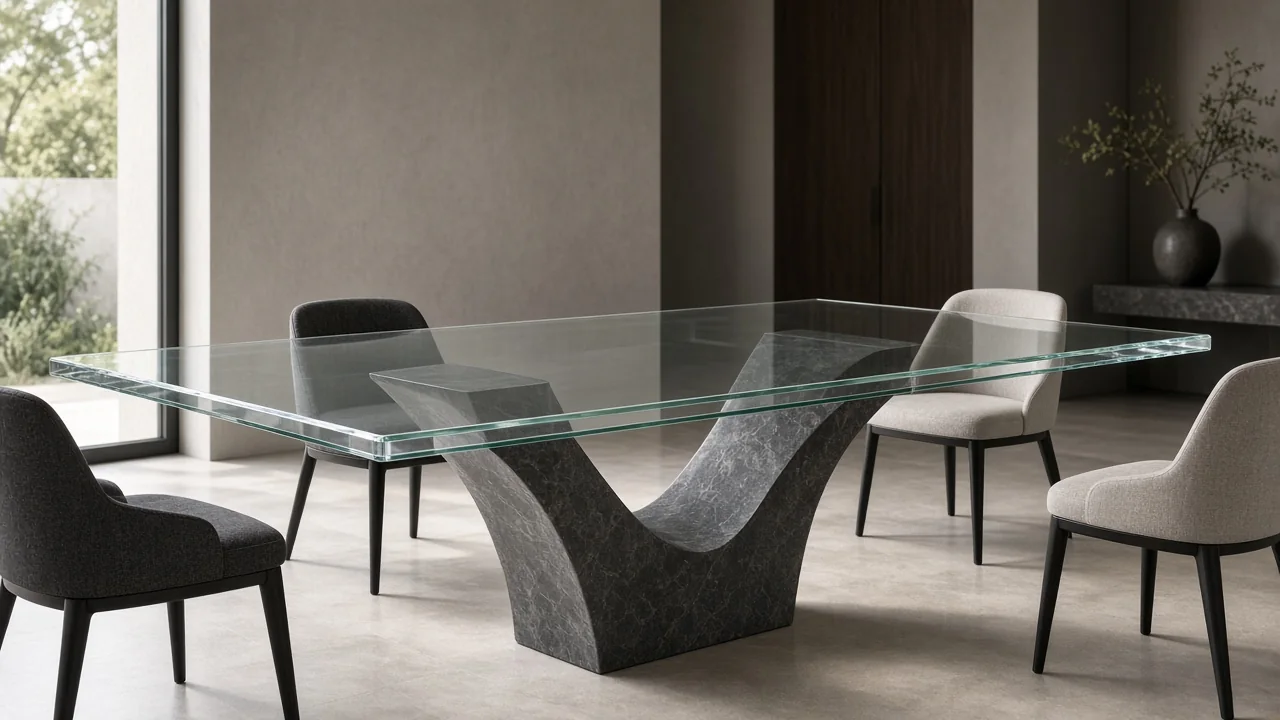
When the glass is the table surface, it spans between a base, legs, or a pedestal and carries dishes, elbows, and whatever gets set down on it.
- Thickness by span. These are typical starting points, not specifications: 3/8 inch is common for coffee tables and small tops with support near the edges, and 1/2 inch is common for dining and conference tables supported around the perimeter. The right thickness for a specific table depends on the unsupported span, where the supports sit, the loads it will carry, the glass type, and the safety requirements that apply. Longer spans, cantilevers, and pedestal bases with a small contact area call for heavier glass and tempering. We confirm the thickness for each table before fabrication.
- Overhang. Keep the glass overhang past the base modest so the top is stable and the edge does not become a lever.
- Base contact. Felt or clear polymer pads between metal or stone bases and the glass prevent point loads and rattles. Glass can also be bonded to a metal base with a UV-cured adhesive for a fixed assembly; ask whether that suits the base you have.
Edgework options
| Edge | Appearance | Best for |
|---|---|---|
| Flat polish | Crisp, modern, square profile | Most tops and covers |
| Pencil polish | Rounded, softer edge | Traditional furniture, children’s rooms |
| Bevel | Angled face that catches light | Formal dining tops, decorative pieces |
| Ogee or custom | Shaped profiles | Reproduction and statement pieces |
Every exposed edge is polished. A seamed edge, which is only sanded, is for glass that will be captured in a frame.
Tempered or annealed
Tempered glass is about four times as strong as annealed glass of the same thickness and breaks into small granules instead of large shards. Choose it for freestanding tops, outdoor tables, glass that cantilevers past its support, and any table where the edge can be struck. The trade-off is that tempered glass is finished before it is tempered: size, shape, corners, and any holes are final once it goes into the furnace.
Clear, low-iron, tinted, and specialty glass
Standard clear glass shows a green edge that grows with thickness; on a 1/2 inch top the edge is distinctly green. Low-iron glass stays clear through the edge and keeps whites true. Gray and bronze tints read as furniture finishes in their own right. Acid-etched, back-painted, and pattern glass are used for display tables and tops that hide what sits under them.
Measuring and templates
Rectangles and circles only need dimensions. Ovals, racetracks, and freeform tops need a template taken from the existing top or traced from the base. If an old glass top broke, keep the largest piece; it is often the fastest way to confirm the shape and the edge profile.
What to send for a quote
The dimensions or a photo of the shape, how the glass will be supported, whether it is a cover or a freestanding top, the edge style, and whether you want standard or low-iron glass. We will recommend a thickness, tell you whether tempering is advisable, and quote fabrication, delivery, and placement.
Common questions
Should a glass tabletop be tempered?
Tempered glass is the right choice for a freestanding top, a patio table, or any table where children lean or sit on the edge. A protective cover that lies flat on a solid wood top is often fine in annealed glass. Tempered glass cannot be cut after it is made, so the size and corners are final before tempering.
What thickness do I need?
A protective cover over a solid surface is usually 1/4 inch. For a freestanding top, 1/2 inch is a common starting point for an edge-supported dining or conference table, but the thickness is sized to the unsupported span, the support layout, the expected load, the glass type, and any safety requirements, not just the overall dimensions. Treat the numbers in this guide as typical examples; we confirm the thickness for your table before fabrication.
Can you match an oval or irregular shape?
Yes. We make a template from the existing top or the base, and the glass is cut to that outline. Send photos and the overall dimensions and we will tell you whether a template visit is needed.