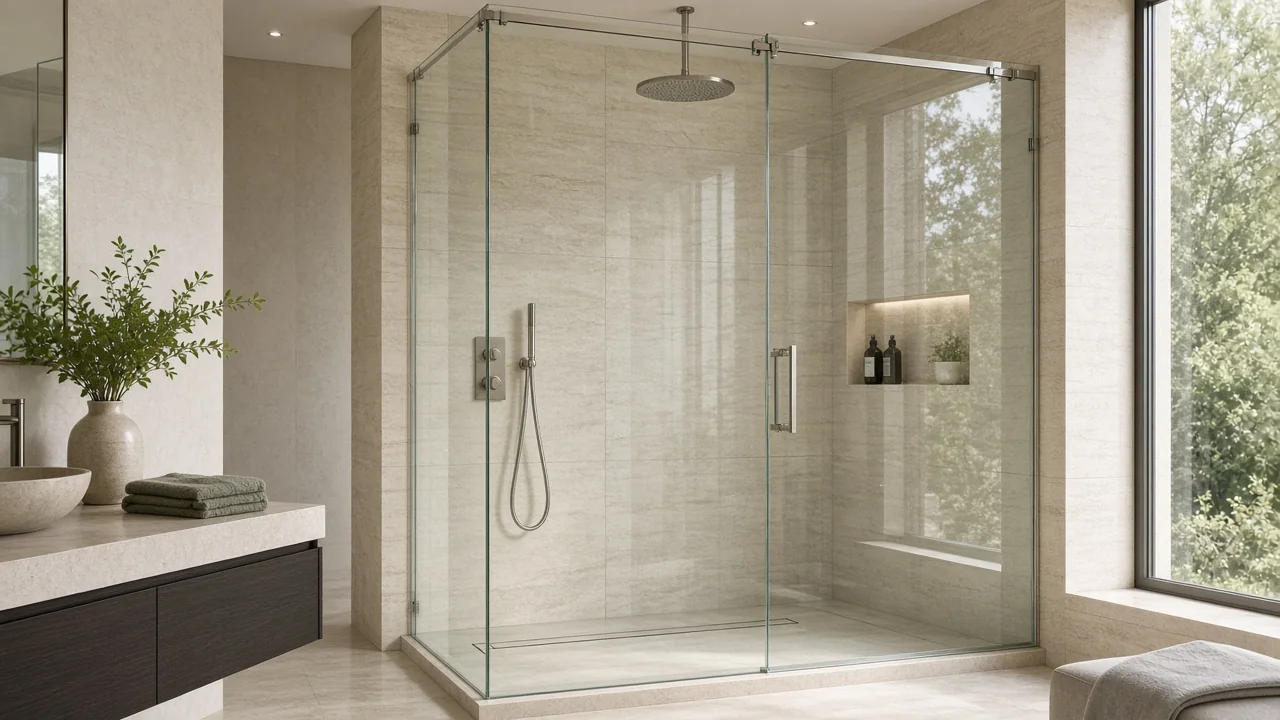

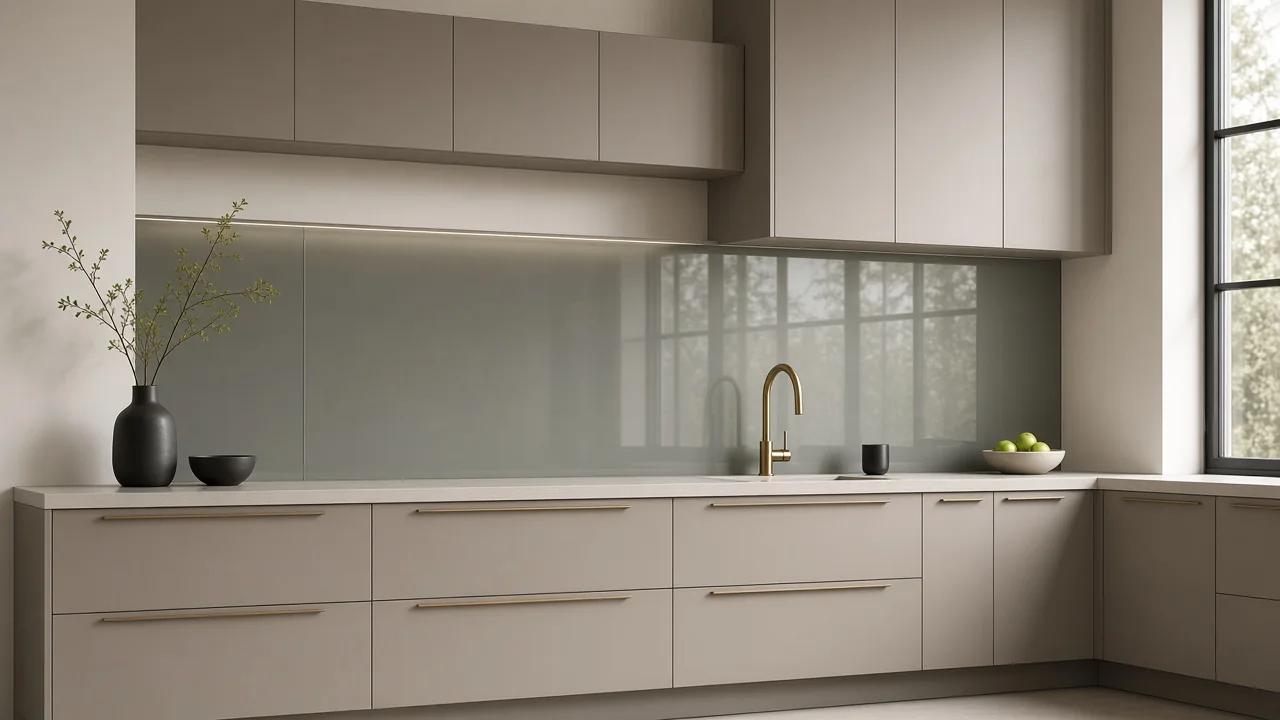
A glass backsplash does three things tile cannot. It installs as one or two large panels instead of hundreds of grouted pieces, it reflects light back into the room, and it can be any color you can mix. Houston kitchens, which tend to be bright and open to the living space, benefit from all three.
This guide covers the decisions that matter: how the glass gets its color, which base glass to choose, when tempering is required, how cutouts are handled, and what to expect during installation.
How back-painted glass works
Back-painted glass is ordinary flat glass with a durable coating applied to the back face. You look through the glass at the color, which is why the finish looks deep and glossy rather than flat. The paint never touches food, steam, or cleaning cloths because it faces the wall.
Three choices control the final look:
- The base glass. Standard clear float glass carries a faint green cast from its iron content. On dark or saturated colors that cast disappears. On white, cream, and pale gray it shifts the color cooler and greener than the paint chip.
- The paint color. Most projects match a manufacturer paint code, a cabinet sample, or a countertop chip. Approve the color on a painted sample viewed through the actual glass before fabrication, because the glass itself shifts the color.
- The surface. A standard polished face is the most common. Acid-etched (satin) glass softens reflections and hides fingerprints, and it can still be back-painted.
When to choose low-iron glass
Low-iron glass has most of the iron removed, so it reads clear and color-true. Choose it when:
- The backsplash is white, off-white, or any pale color where a green cast would be obvious.
- The glass meets a white quartz or marble countertop and the two surfaces need to match.
- The backsplash will be clear or lightly tinted and the wall behind it stays visible.
For deep blues, charcoal, black, or metallic colors, standard clear glass is usually indistinguishable from low-iron once painted, and it keeps the cost down.
Mirror and printed alternatives
A mirror backsplash makes a small kitchen or a bar feel larger and doubles the light from a window. Antique mirror finishes add texture and are more forgiving of water spots than a bright clear mirror. We recommend mirror at the bar, the coffee station, or a butler’s pantry more often than directly behind a cooktop, where splatter is constant.
Digitally printed glass puts a photo, a pattern, or a stone look between the glass and the wall. It is a good way to get a marble or concrete appearance with far fewer joints than tile and none of the sealing that natural stone needs.
Tempering behind the range
Glass behind a cooktop sees heat from the burners and the occasional pot handle. We recommend tempered safety glass there, and we check the appliance manufacturer’s installation instructions for required clearances or materials behind and beside the range before the panel is finalized. Tempering heats and rapidly cools the glass so it is several times stronger than annealed glass and breaks into small granules rather than shards.
One consequence shapes the whole process: tempered glass cannot be cut or drilled afterward. Every outlet box, switch, window edge, and hood notch is located on a template and cut into the glass before it is tempered. The color goes on after tempering: standard back-paint coatings are applied to the finished, tempered panel, because they would not survive the tempering furnace. The exception is ceramic frit, a glass-based color that is fired on during tempering and is specified when the color has to be part of the tempered glass itself. That is why we template after cabinets, counters, and rough electrical are complete and the outlet boxes are set to their final positions.
Thickness, seams, and panel size
Most residential backsplashes use 1/4 inch (6 mm) glass. It is rigid enough to install flat and light enough to handle in a kitchen. Long runs are split into two or three panels with hairline joints; placing a joint at a window edge, a corner, or behind the range hood usually hides it. We confirm panel sizes against the stairwells, doors, and turns the glass has to travel through to reach the kitchen.
Installation
Glass backsplash installation is usually a single visit once the panels arrive:
- The wall is checked for flatness. High spots are knocked down so the glass does not rock.
- Panels are set in a neutral-cure silicone or mirror mastic that will not react with the paint.
- Edges at the counter and the upper cabinets are sealed with a clear silicone bead.
- Outlet covers and the range hood trim go back on over the glass.
There is no grout to cure, so the kitchen is usable the same day.
What to have ready for a quote
Send us the wall dimensions, the number and positions of outlets and switches, whether the range has a hood or a microwave above it, the paint color or sample you want to match, and a few photos of the space. We will confirm whether the project needs tempered glass, recommend standard or low-iron glass for the color, and quote the glass, the color, and the installation together.
Common questions
Does a glass backsplash have to be tempered?
Behind a cooktop or range we recommend tempered glass because of the heat and the risk of impact, and the appliance manufacturer's installation instructions may require specific clearances or materials behind and beside the appliance. For a bar or a laundry wall, annealed glass is often acceptable. Large panels and panels with many cutouts are usually tempered as well, but the final call depends on the location, the exposure, and the safety-glazing rules that apply to it.
Can you cut a glass backsplash on site?
No. Tempered glass cannot be cut or drilled after tempering, so every outlet, switch, and window cutout is measured first and cut before the panel is tempered. Standard back-paint is applied to the finished, tempered panel; ceramic frit color is fired on during tempering. We template after the counters and cabinets are installed.
How do you clean back-painted glass?
The painted face is against the wall, so you only ever touch bare glass. A glass cleaner and a microfiber cloth keep it clear. There is no grout, and nothing for grease to soak into.