
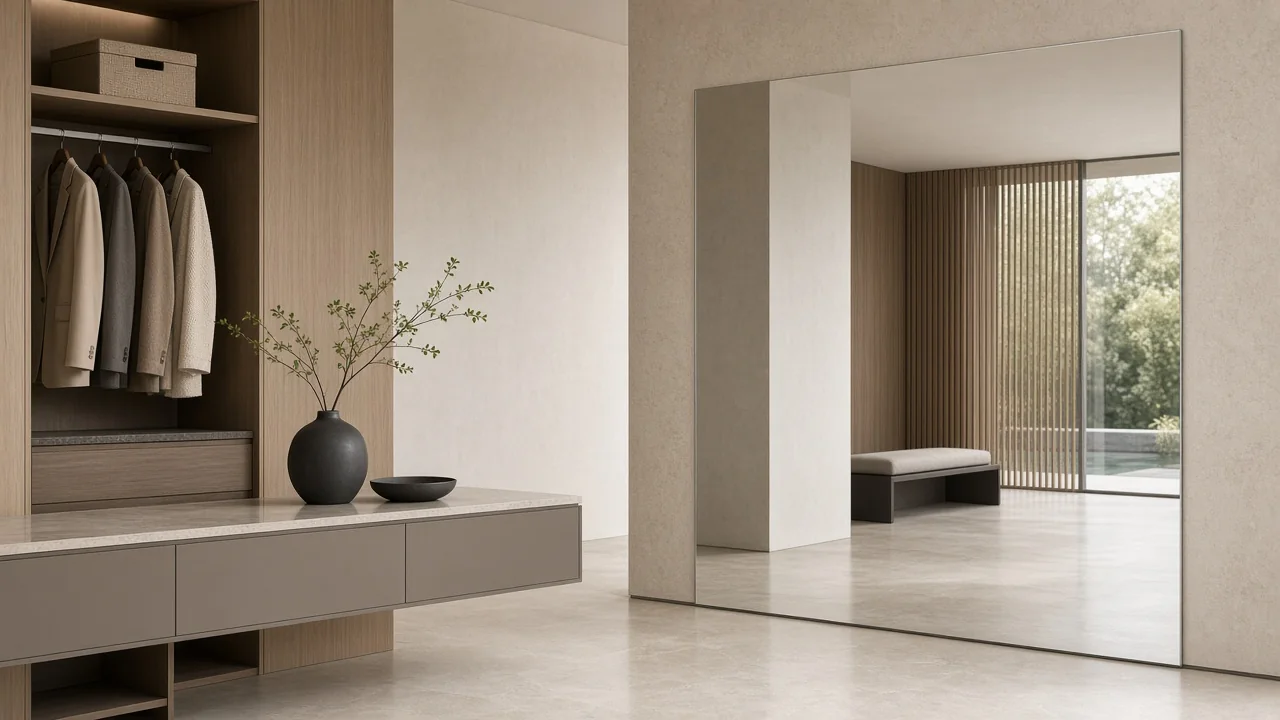
A custom mirror is the fastest way to make a bathroom, a hallway, or a workout room feel larger and brighter. The decisions that matter are the thickness, the edge, how the mirror is mounted, and how it is protected from moisture over the years.
Thickness and size
Most residential wall and vanity mirrors are 1/4 inch (6 mm) clear mirror. That thickness stays flat over a vanity or a full wall and avoids the slight waviness thinner mirror can show in a large panel. Thinner mirror is mainly used for small pieces held in a frame.
The practical size limit is usually the path into the room, not the glass. A single panel has to fit through doors, around stair turns, and into the space without flexing. For a long wall, the run is split into panels, and the joints are placed where the eye expects a line: at a vanity divider, a column, or a change in the wall.
Edges
A flat polished edge is the standard finish for a frameless mirror and reads as clean and modern. A beveled edge adds a narrow band of angled glass around the perimeter that catches light; it suits traditional rooms and makes a single mirror look finished without a frame. Exposed corners can be eased or radiused so there is no sharp point at hand height, which matters on a vanity mirror that people lean toward every day.
Mounting
There are two common methods, and many installations combine them:
- Adhesive. A mirror-compatible mastic or adhesive is applied to the back, typically in vertical beads so air can move behind the glass while it cures. The bottom edge rests on a J-channel or clips so the glass is mechanically supported and the adhesive is not carrying its full weight alone. This gives the cleanest frameless look.
- Mechanical. Clips, cleats, or a channel hold the mirror without relying on adhesive. This suits very large or heavy panels, walls that are not flat, and mirrors you may want to remove later.
The adhesive matters more than it looks. Some general-purpose construction adhesives react with the protective paint on the back of a mirror and cause the silver to darken. Adhesives labeled for mirror installation are formulated to avoid that.
Outlets, switches, and sconces that fall inside the mirror are located on a template and cut out before installation, so the cover plates sit on the glass or the wall exactly where they belong.
Humidity
Houston bathrooms stay humid for much of the year, and humidity is the main threat to a mirror’s life. The silver layer on the back is protected by paint, and the vulnerable point is the edge, where moisture can creep in. Four habits make the biggest difference:
- Keep the bottom edge out of standing water. A mirror that sits directly on a backsplash or countertop can wick water up behind the glass; a small gap or a sealed edge prevents it.
- Use an edge sealant or protective edge treatment where the mirror is near a sink or shower.
- Run the exhaust fan during showers and for a while afterward.
- Clean with a soft cloth and spray the cleaner onto the cloth, not the glass. Ammonia and vinegar running down to the edge attack the backing over time.
Antique mirror
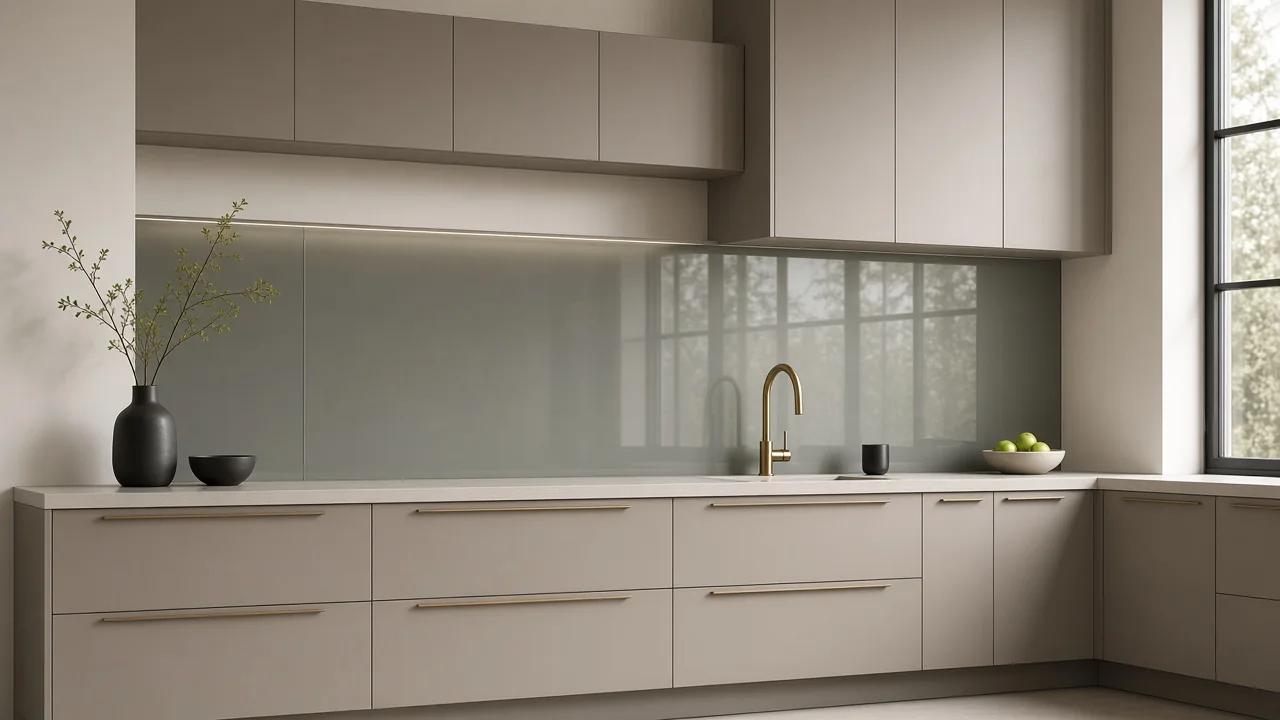
Antique mirror adds a mottled, aged pattern to the reflection. It works well on a bar wall, in a powder room, or as an accent panel, and it forgives water spots and fingerprints better than bright clear mirror. It also appears as a glass backsplash option, usually at a bar or coffee station rather than directly behind a cooktop.
Home gyms
A wall of mirror in a workout room is usually 1/4 inch clear mirror run from a little above the floor to a comfortable height above the tallest user. Two details matter here:
- Safety backing film. Applied to the back of the mirror, it holds the pieces together if the glass is struck by a weight or a ball. It is a sensible default in any room with equipment or children.
- Protection at the bottom. A raised base or a rubber floor edge keeps dropped equipment away from the bottom of the glass.
Mechanical mounting is common in gyms because the mirror can be removed later if the room changes use.
What to send for a quote
- The wall dimensions, and the height where you want the mirror to start and finish.
- The position of sconces, outlets, and switches that fall inside the mirror.
- The edge style you want (polished or beveled).
- Clear or antique mirror.
- A few photos of the wall and the path into the room.
We will recommend a thickness, a mounting method, and a panel layout, and quote fabrication and installation together.
Common questions
What causes black edges on a bathroom mirror?
Moisture or harsh cleaners reaching the silver layer from the edge, a condition called desilvering. Sealed or protected edges, a mirror-compatible adhesive, keeping the bottom edge out of standing water, and spraying cleaner onto the cloth instead of the glass all help. Once the silver has started to darken, replacing the mirror is the only fix.
Can a mirror be cut after it is made?
Standard (annealed) mirror can be cut, notched, and drilled for outlets and sconces. Tempered mirror, used where safety glazing is required, cannot be modified after tempering, so every cutout is confirmed before it is fabricated.
Does a bathroom mirror have to be safety glass?
Usually not. The International Residential Code generally treats a mirror mounted on a wall with continuous backing support differently from glass in a door or a shower enclosure. A mirror on a door, such as a closet door, is a different case. The code your city has adopted and the local building official decide what applies to a specific location.
How thick should a wall mirror be?
For vanities and full walls, 1/4 inch (6 mm) is the typical choice because it stays flat and reflects without visible distortion. Thinner mirror is used mainly for small framed pieces.