
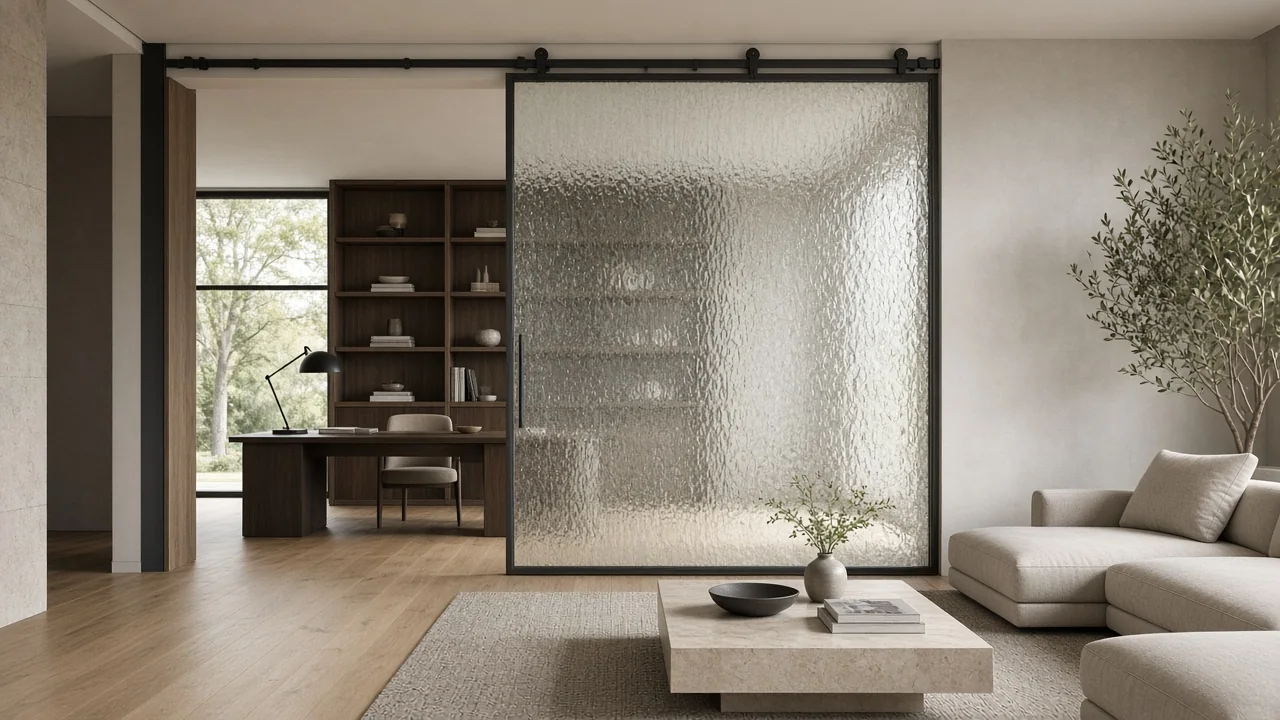
A home office needs a door that closes for calls and concentration, but a solid door turns a small room into a box. A glass barn door or a glass insert in a swinging door keeps the light moving between rooms while still giving the office its own space. With more Houston homeowners working from home and converting spare bedrooms, dens, and dining rooms into offices, it is one of the most common ways glass is added during a renovation.
Barn door or swinging door
A sliding barn door hangs from a track above the opening and slides along the wall. It needs clear wall space beside the opening at least as wide as the door, with no light switches, outlets, or trim in the way. A swinging door with a glass insert needs floor space to open into instead. In a narrow hallway or a room with furniture near the doorway, the barn door usually fits better; where the wall beside the opening is busy, a swinging door is simpler.
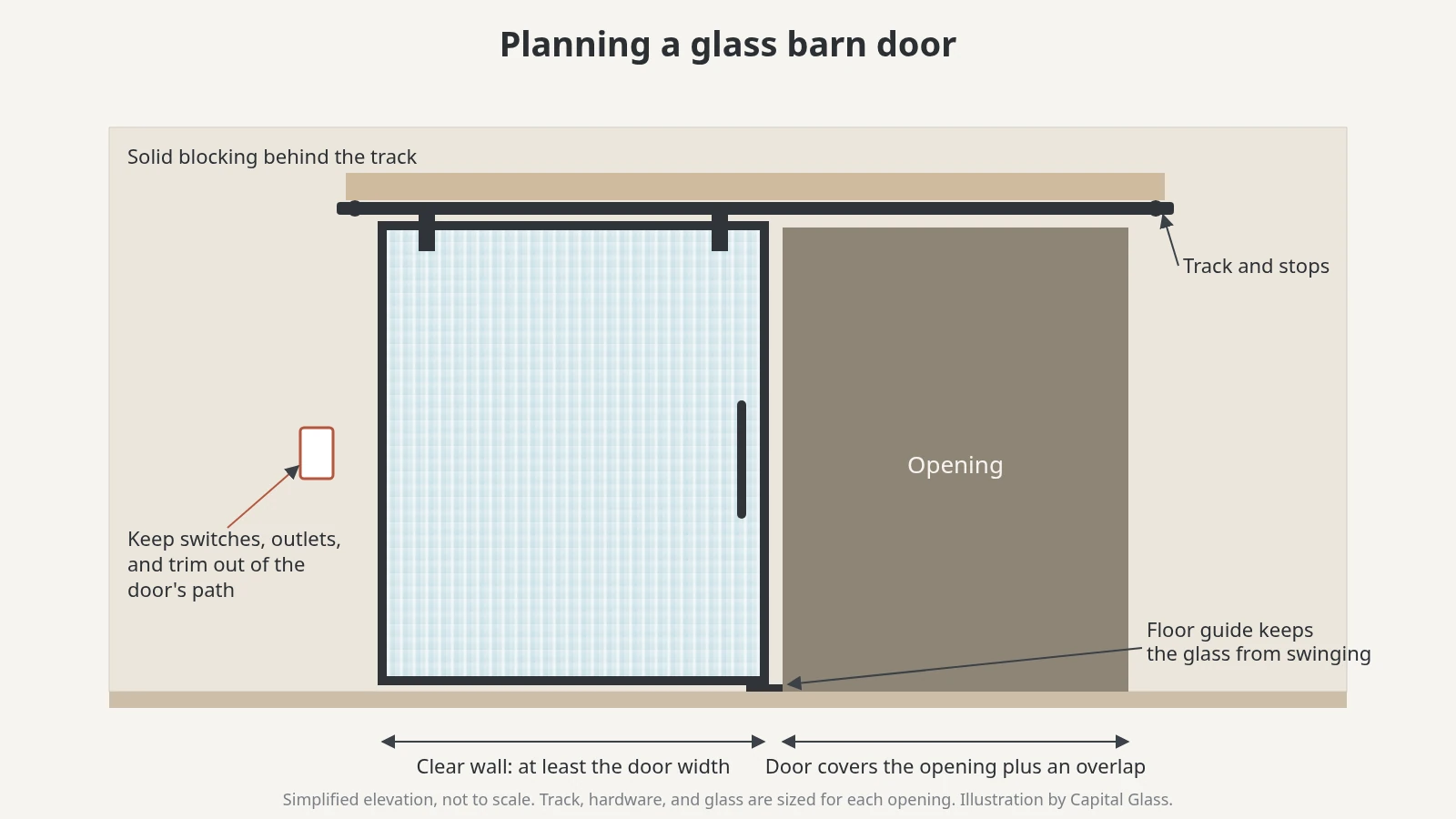 Simplified elevation, not to scale. Illustration by Capital Glass.
Choosing the glass
- Clear glass keeps the office visually part of the room. It suits a space that is tidy and where privacy is not the goal.
- Reeded or textured pattern glass blurs what is behind it while keeping light and shapes; it is the most popular choice for offices.
- Acid-etched glass gives an even satin finish and the most privacy, which helps when the desk faces the door or a screen faces the doorway.

Glass in a door must be safety glass, tempered or laminated, and a sliding door panel is usually thick tempered glass held by hardware at the top. Our decorative glass guide compares how much each glass type hides.
Framed or frameless
A frameless glass barn door is a single tempered panel with polished edges and hardware clamped or bolted through the glass; it is the lightest look. A framed door holds the glass in a metal or wood frame, often with divided lites, which suits a more traditional or industrial room and lets thinner glass be used.
Hardware
Barn door hardware comes in matte black, stainless, brushed nickel, and brass finishes. The track must be anchored into solid blocking above the opening, because a glass door is heavy. A floor guide keeps the glass from swinging out at the bottom, and stops at each end of the track set the open and closed positions. Soft-close dampers are worth adding on heavy glass doors so they do not slam.
Sound and privacy
A barn door leaves a small gap around the opening, so it does not block sound the way a sealed swinging door does. If the office is used for video calls or confidential conversations, a swinging door with a glass door insert, weatherstripping, and a door bottom keeps sound in far better. Visual privacy is a separate choice: frosted or reeded glass on either type of door blocks the view while keeping the light.
Glass inserts in existing doors
If the office already has a solid door, a glass insert is often the simplest upgrade: a panel is cut out of the door and replaced with safety glass held in a frame or by glazing stops. It brings in light without changing the opening or the hardware. Solid-core doors convert best; hollow-core doors usually are replaced instead.
What to send for a quote
- The opening width and height, and the wall space beside it.
- Photos of the doorway and the wall, showing switches and outlets.
- The glass look you want, framed or frameless, and the hardware finish.
- For an existing door, its size and whether it is solid-core.
We will recommend the door type, glass, and hardware, and quote fabrication and installation together. See our glass barn doors options, or request a quote.
Common questions
Can a barn door be glass?
Yes. Glass barn doors are made from thick tempered glass, either frameless with hardware attached through the glass or held in a metal frame. Clear, reeded, frosted, and patterned glass are all common, depending on how much privacy the room needs.
Do glass barn doors block sound?
Not well. A barn door hangs in front of the opening with small gaps around it, so it limits sound much less than a sealed swinging door. For an office used for frequent calls, a swinging door with a glass insert and good seals is the quieter choice.
How much wall space does a barn door need?
The wall beside the opening needs clear space at least as wide as the door, with no switches, outlets, vents, or trim in the door's path, plus solid blocking above the opening for the track. Where that space is not available, a swinging door with a glass insert or a pocket door may fit better.