
Glass broke across the Houston area in 2024. The May derecho blew out windows in downtown towers, and Hurricane Beryl brought down trees and debris across the region two months later. Since then, more owners, tenants, and contractors have been asking the same question: do we need impact glass?
The answer depends on where the building is, what the code and insurer require, and what the owner wants the storefront to withstand. This guide explains how that is decided and what an impact-rated storefront or entrance actually involves.
When impact protection is required
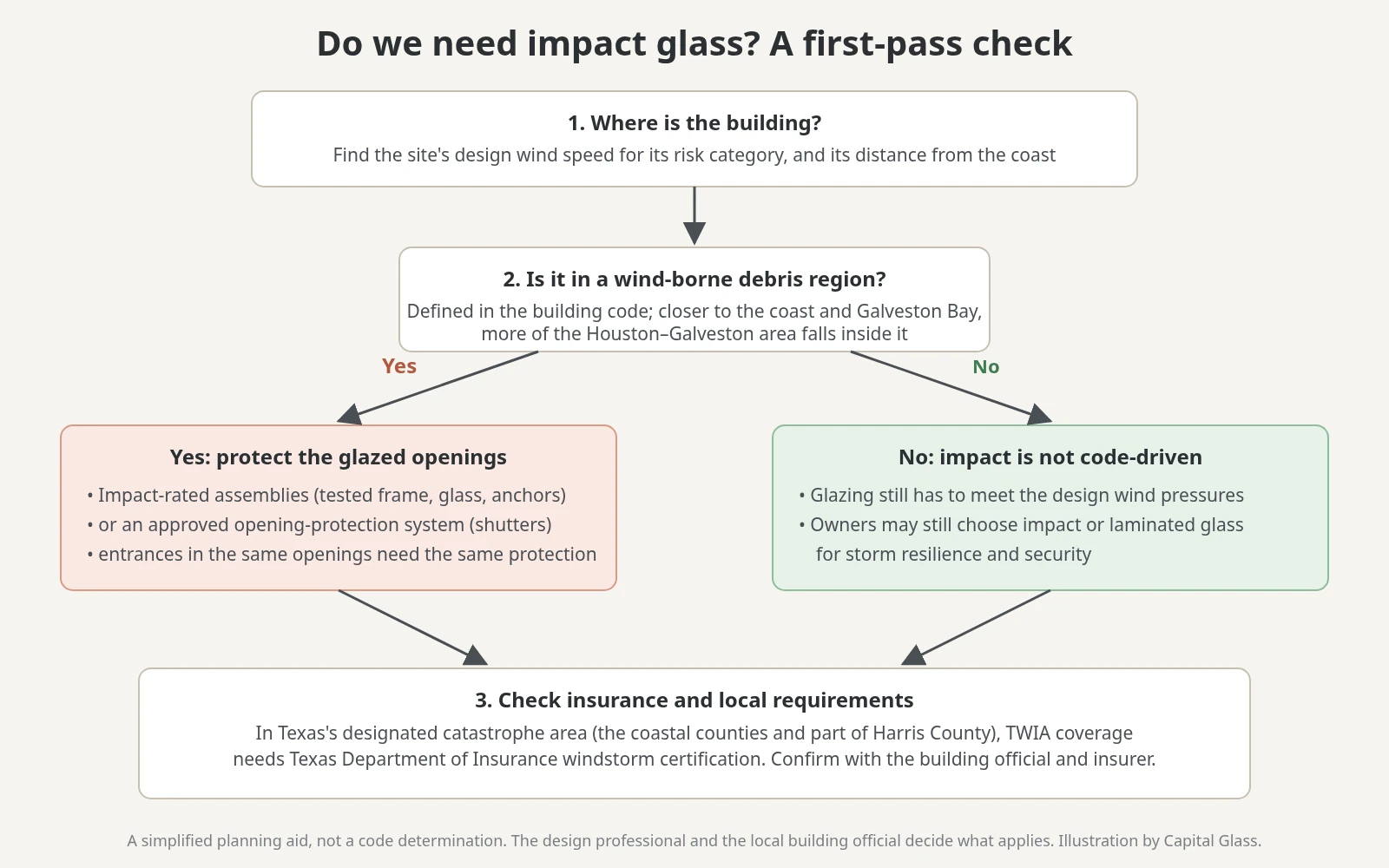 A simplified planning aid, not a code determination. Illustration by Capital Glass.
The building code. The City of Houston enforces the 2021 International Building Code with Houston amendments (the Houston Construction Code, in effect since January 1, 2024); surrounding cities and counties adopt their own code editions, so check the jurisdiction for each site. The code defines wind-borne debris regions based on the site’s design wind speed and its distance from the coast. In those regions, glazing must be impact-resistant or protected with an approved opening-protection system such as tested shutters, with limited exceptions, for example for some glazing high above the ground. Sites closer to the coast and Galveston Bay are more likely to fall inside these regions than inland Houston; the determination is made for each site and building risk category.
Insurance and the Texas windstorm program. In the Texas Department of Insurance’s designated catastrophe area, which covers the coastal counties and part of Harris County, buildings insured through the Texas Windstorm Insurance Association need windstorm certification of the construction, including the glazing. TDI’s program has its own code basis, separate from the city’s: windstorm certifications from April 1, 2026 are made under the 2024 International Building Code and International Residential Code as adopted by TDI, with TDI’s wind speed criteria, while earlier work falls under the 2018 codes. A project in that area can therefore have to satisfy both the local building code and TDI’s windstorm requirements, and they do not necessarily match. That affects which products and installation methods can be used.
Owner choice. Outside those areas, impact protection is usually not code-driven, but many owners still choose impact-rated or laminated glazing for storm resilience, security, and business continuity.
What “impact-rated” actually means
An impact rating is earned by testing a complete assembly. Typical tests strike the glazing with a missile, a large timber for openings near the ground or small steel balls higher up, and then cycle it through many positive and negative wind pressures. The test method is ASTM E1886, and results are judged against the acceptance criteria of the applicable specification (commonly ASTM E1996) or the code. Those criteria permit some damage, such as cracked glass and limited tears or openings, within set limits. A passing result means the assembly met those criteria under test conditions; it is not a guarantee that a building will stay undamaged or sealed in a real storm.
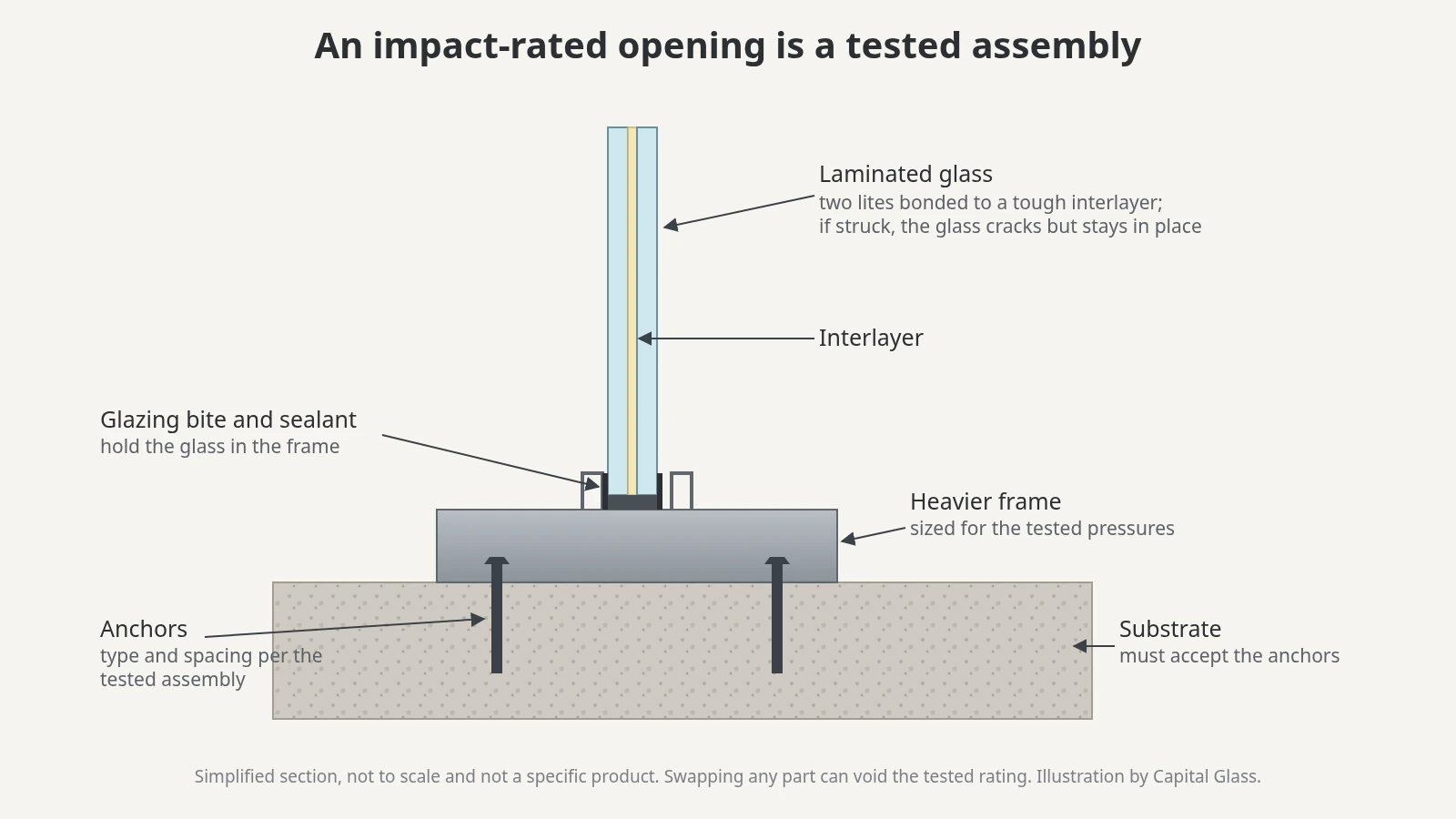 Simplified section, not to scale and not a specific product. Illustration by Capital Glass.
Because the rating belongs to the assembly, every part matters:
- Laminated glass. Most impact glazing uses laminated glass: two or more lites bonded to a tough interlayer. When it is struck, the glass cracks but the interlayer holds it in the frame.
- The frame and glazing. Impact storefront framing is heavier than standard storefront, with a deeper glazing pocket and glazing methods that keep the glass in place under load.
- Anchors and substrate. Anchor type, size, and spacing come from the tested assembly, and the substrate has to accept them. Concrete, masonry, and steel each need their own fastening.
- Entrances. Doors in a protected opening must be part of a tested system as well, including the door hardware. Entrance sizes and configurations can be limited by what has been tested.
Substituting any one component, such as a different glass make-up or a different anchor, can mean the opening no longer matches its tested rating.
What changes on the project
- Sizes and layouts. Tested assemblies have size limits, so very large lites or unusual layouts may need to be divided differently.
- Lead time. Laminated glass and impact framing take longer to produce than standard storefront, which matters for the schedule.
- Weight and handling. Impact glass is heavier, which affects installation and the equipment needed on site.
- Documentation. Product approvals, test reports, and installation instructions become part of the submittals, and the installation has to follow them.
- Existing storefronts. New impact glass in old frames does not create a rated opening. Where protection is required, a storefront replacement usually replaces the frame, glass, and anchors together, and it can be phased to keep the business open.
Planning an impact storefront in Houston
- Confirm the requirement early. Ask the design professional to confirm the wind-borne debris determination, the design pressures, and any windstorm certification needs before the system is selected.
- Specify the system, not just the glass. The drawings and specifications should name an impact-rated storefront and entrance system that covers the openings as drawn.
- Coordinate the substrate. Make sure the structure at the head, sill, and jambs can take the anchors the system requires.
- Allow for submittals and lead time. Product approvals and shop drawings take time to review; plan the glass order around them.
For how storefront compares with heavier wall systems, see our curtain wall vs. storefront guide, and for what a complete bid package should include, our bid package guide.
What to send for a bid
- The project address and building use.
- Drawings and the storefront, entrance, and glazing specification sections.
- The design pressures and the impact or opening-protection requirement, if already determined.
- Whether windstorm certification is required.
- For existing buildings, photos of the current storefront and the substrate.
Capital Glass reviews impact-resistant storefront and entrance scopes as complete assemblies, against the project documents. Invite Capital Glass to bid, or read how we approach impact-resistant glazing.
Common questions
Is laminated glass the same as impact glass?
No. Laminated glass is one component of most impact-rated assemblies, but an impact rating belongs to the tested combination of glass, frame, glazing, and anchors. Laminated glass in an ordinary storefront frame is safer and more secure than plain glass, but it is not an impact-rated opening.
Do all Houston commercial buildings need impact glass?
No. Whether impact protection is required depends on the building's location and risk category under the building code, and on local and insurance requirements. Sites closer to the coast and Galveston Bay are more likely to fall in a wind-borne debris region than inland Houston. The design professional and the building official make the determination for each project.
Can we put impact glass in our existing storefront frames?
Usually not as an impact-rated upgrade. Impact ratings come from testing the complete assembly, so new glass in an existing frame does not create a rated opening. Where impact protection is required, the frame, glass, and anchors are typically replaced together with a tested system, or an approved opening-protection product is added.